The toyo steel toolbox y-350 is the kind of storage box that makes sense when your garage bench is crowded but you do not need another rolling cabinet. I have lived with small metal tool boxes through enough Ohio winters, remodel jobs, and half-finished repairs to know the difference between useful compact storage and a handsome nuisance. This one is interesting because it is simple: painted steel, a single lift-up lid, a handle, and no drawer slides to collect grit or fail.
That simplicity is the whole appeal. You get a portable home for sockets, screwdrivers, measuring tools, electrical supplies, or the small hand tools that otherwise migrate across the bench. You do not get room for a full mechanic's collection. Understanding that tradeoff before ordering is the key to being happy with it.
What the toyo steel toolbox y-350 is built for
Think of the toyo steel toolbox y-350 as a grab-and-go bench box, not a replacement for a five-drawer tool chest. Its steel shell gives it a more solid feel than the thin plastic cases sold at big-box stores, and the traditional rectangular shape uses shelf space efficiently. The lid and handle also make it practical for carrying a selected group of tools to a car in the driveway, a workbench in the basement, or a project in the backyard.
The compact footprint is useful in a garage where every square inch already has a job. On my own bench, small boxes tend to become junk trays unless they have a clear purpose. This one works better when assigned to a category: layout tools, trim tools, fasteners, or electrical repair supplies. A mixed box becomes frustrating quickly because the usable capacity disappears under loose odds and ends.
The steel construction is not magic armor. Do not use it as a step, leave it outside, or toss a wet socket set inside and close the lid for a month. Wipe condensation and road salt away, especially if the box rides in a truck. A thin film of light oil on the hinge and a dry cloth on the interior are cheap insurance against surface rust.

How I would load the toyo steel toolbox y-350
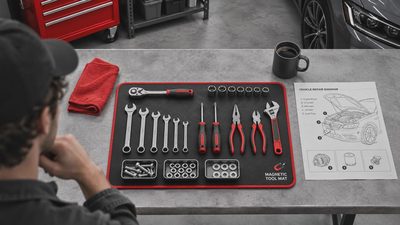
Start with the tools you reach for repeatedly, not the tools you own. A sensible first load might include a 16-foot tape measure, combination square, utility knife, marking pencils, six to eight screwdrivers, a compact ratchet set, pliers, hex keys, and a small adjustable wrench. That is enough for cabinet work, household repairs, and many garage maintenance jobs without turning the box into a heavy metal brick.
For automotive work, I would use it as a secondary kit. Keep trim tools, test leads, magnetic pickup tools, a tire gauge, fuses, small sockets, and a 3/8-inch ratchet inside. Leave large extensions, impact sockets, breaker bars, and specialty pullers in a deeper cabinet. The box is much easier to carry when it holds the tools for one task instead of every tool for every possible breakdown.
A useful trick is to put consumables in small metal or plastic tins before they go into the main compartment. Electrical connectors, razor blades, screws, and spare driver bits otherwise spread across the bottom. I have screwed this up so you do not have to: dumping a handful of fasteners into a portable box feels convenient on day one, then costs ten minutes every time you need a particular size.
The y-350 format also suits a dedicated restoration kit. I keep old hand-tool projects separate from construction tools because brass brushes, honing supplies, small files, and replacement hardware do not belong loose beside framing nails. A labeled box saves more time than a larger box with no system.
Where the toyo steel toolbox y-350 falls short
The main limitation is capacity. If your daily work involves a full set of pliers, multiple ratchets, deep sockets, a hammer, and power-tool accessories, you will outgrow it. The lid style also means you need to lift the top before reaching the lower tools. That is fine for a curated kit, but less convenient than shallow drawers when you are working through a long repair.
There is no honest reason to buy this box for storing a drill, charger, and several batteries. A deeper plastic organizer or a small modular case will handle that job better. Likewise, a professional mechanic who needs impact-rated sockets and heavy wrenches should look at a larger steel chest or rolling cart. The toyo steel toolbox y-350 earns its place through portability and discipline, not raw volume.
Painted steel can also show scratches. That is not a dealbreaker in a working garage; scratches are part of the record. Still, avoid dragging it across a concrete floor and do not stack a heavy compressor on top. If the box arrives with a lid that feels misaligned, correct it early rather than forcing the hinge. A few careful adjustments are preferable to bending the steel around the latch.

A practical garage setup around this box
I would place the toyo steel toolbox y-350 on a shelf between waist and chest height, with the handle facing outward. That keeps it visible without consuming the prime section of the workbench. A shelf lip or a strip of 1-by-2 lumber at the front prevents it from walking forward when the garage door vibrates or someone bumps the bench.
For a wall-mounted setup, leave enough clearance to open the lid fully. Measure the box with the handle raised, not just the closed footprint. This is the sort of small mistake that looks harmless on paper and becomes annoying every day. I have installed shelves too close together and then had to move them after loading the tools.
If you use a French cleat wall, mount a small shelf rather than hanging the box directly from a bracket unless the hardware is rated for the loaded weight. A portable steel box becomes surprisingly heavy once filled with sockets. Keep the shelf fastened into studs or use appropriate anchors for the wall material. Storage should not become a falling-object problem above a vehicle or work surface.
Is the toyo steel toolbox y-350 worth buying?
For a homeowner who wants one compact, durable box for a defined group of hand tools, the toyo steel toolbox y-350 is a sensible purchase. Its strongest points are the straightforward steel construction, portable size, and old-school design that does not depend on plastic catches or complicated drawer hardware. It looks at home in a working garage rather than a showroom.
I would buy it for a trim carpenter's small kit, a home electrical repair box, a tool-restoration setup, or a grab-and-go automotive kit. I would not buy it as the only storage solution in a serious workshop. Pair it with a wall cabinet, pegboard, or rolling chest and it becomes more useful because it handles the tools you need at the point of work.
Before ordering, measure your largest planned tool and compare that measurement with the listed interior dimensions. Also decide whether you want open-compartment storage or drawers. If those answers fit the job, this small Japanese-style steel box should deliver years of practical service. It is not a storage miracle, and that is fine. A tool box does not need to do everything; it needs to do its assigned job without making you fight it.
Back to the bench.