
Radiant garage heaters are one of the better ways to make a cold workshop usable without trying to heat every cubic foot of drafty air. Instead of blasting warm air around the room, they send infrared heat toward your workbench, floor, tools, and body. I have worked in attached garages where the air temperature barely moved after an hour of heating, yet the person standing under a properly placed unit was comfortable. That difference matters when you are tuning a carburetor, finishing a cabinet, or simply trying to keep your fingers working.
The right choice depends on your garage size, insulation, ceiling height, electrical service, and whether you store gasoline or other flammable materials. A two-car garage in Columbus, Ohio, has different demands than a detached shop in Arizona. Before buying, look at the heat source, mounting location, controls, and installation requirements rather than shopping by the lowest price.
How radiant garage heaters work
Radiant heat travels from a hot element or burner to nearby surfaces, much like sunlight warming your face on a cold day. An electric infrared panel or tube heater warms objects in its path. Those objects then release some heat back into the room. This is why radiant garage heaters can feel effective even when the garage door opens frequently or the building envelope is not perfect.
Forced-air heaters work differently. They heat air and circulate it with a fan. That approach can raise the overall room temperature faster in a well-insulated garage, but it also stirs dust and loses heat through door gaps. Radiant equipment is more targeted. If your main goal is keeping one bench, motorcycle lift, or assembly area comfortable, you do not necessarily need to heat the entire 500-square-foot floor.
There is a catch: radiant heat needs a clear line of sight. A unit mounted behind shelving will not warm the work area effectively. A low ceiling fan, hanging storage rack, or tall vehicle can also block the pattern. Plan the coverage before drilling holes.

Electric versus gas options
Electric radiant garage heaters are usually the simplest choice for an attached garage. They do not produce combustion gases, require no flue, and are available in compact wall- or ceiling-mounted designs. A 1,500-watt portable infrared heater can warm a small work zone, while larger 4,000- to 6,000-watt units are better suited to a substantial shop. The limitation is electrical capacity. A 4,000-watt heater draws roughly 16.7 amps at 240 volts, so it often needs a dedicated circuit installed by an electrician.
Natural gas and propane infrared heaters can deliver serious heat without placing the entire load on your electrical panel. Brands such as Mr. Heater and Modine offer common garage heating solutions, but fuel-burning equipment requires correct clearances, ventilation, and installation. A vent-free heater is not automatically appropriate for an attached garage. Moisture, carbon monoxide, and combustion byproducts are real concerns, especially in a tightly sealed space.
Gas can be attractive when you already have a gas line and a larger garage to heat. Electric often wins for a small insulated workspace because installation is cleaner and control is straightforward. Get quotes before deciding: a dedicated electrical circuit might run about $300 to $900, while gas piping, venting, and professional installation can cost substantially more depending on access.
Sizing and placement without guesswork
Start with the garage dimensions and insulation condition. A finished, insulated two-car garage may need roughly 15,000 to 30,000 BTUs of heating capacity in a cold climate, while a leaky uninsulated space can need far more. Those are planning ranges, not a replacement for a heat-load calculation. Oversizing creates short cycling and uncomfortable hot spots; undersizing leaves you wearing a coat at the bench.
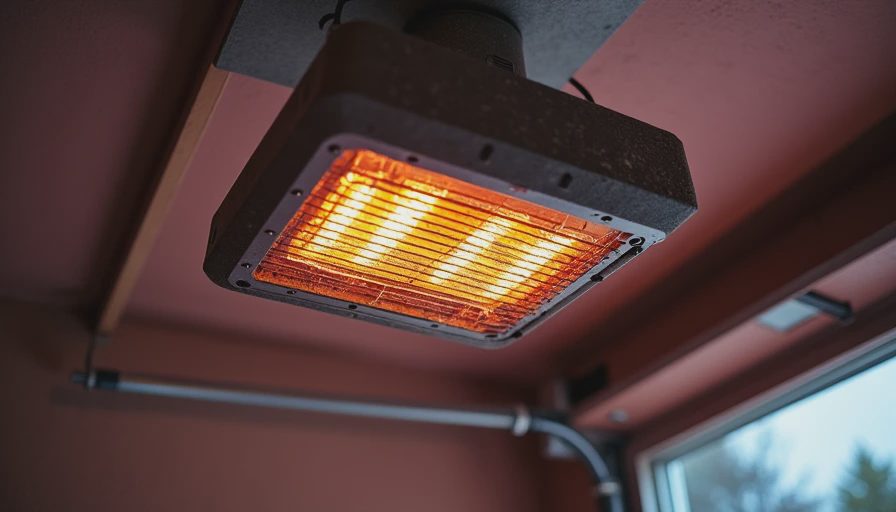
For radiant garage heaters, mounting height is just as important as output. Follow the manufacturer’s clearance requirements above vehicles, shelving, drywall, and stored lumber. A ceiling-mounted unit aimed across the main work zone usually works better than one pointed straight down at a vehicle hood. I prefer placing the heater so my shoulders and hands sit inside the main heat pattern while I work, rather than mounting it near the garage door where much of the output disappears outside.
Keep the heater away from sawdust piles, paint storage, cardboard, and fuel containers. Do not use a portable unit as a permanent substitute for fixed wiring or proper mounting. A heater that gets bumped by a ladder is not a bargain.
Controls, running cost, and daily comfort
A thermostat is useful for maintaining a baseline temperature, but radiant heat also rewards zone control. I often set the garage at a modest 45 to 50 degrees when I am not working, then use a timed or local control to warm the bench before starting a project. Heating the entire room to 70 degrees all day is expensive and unnecessary if you spend most of the afternoon in one corner.
Electric operating cost is easy to estimate. A 4,000-watt heater running continuously uses four kilowatt-hours per hour. At 16 cents per kilowatt-hour, that is about 64 cents per hour before thermostat cycling reduces the actual total. A 1,500-watt unit costs about 24 cents per hour at the same rate. Gas costs depend on fuel prices, efficiency, and runtime, so compare the installed system rather than assuming one fuel is always cheaper.
Insulation still matters. Weather-strip the bottom and sides of the garage door, seal penetrations around wiring, and insulate exposed walls and the ceiling where practical. I painted my own garage floor before fixing the door seal; the heater ran constantly, and the room still felt cold. I eventually tore out part of that setup and addressed the leaks first.
Safety details that deserve attention
Use a heater listed by a recognized testing laboratory and install it according to the manual. Keep the required clearance around the housing, element, and exhaust. Never drape extension cords, tarps, or clothing over the equipment. If the unit is electric, use the correct circuit and wiring method rather than a light-duty extension cord snaking across the floor.
Fuel-burning radiant garage heaters need working carbon monoxide alarms in nearby areas, especially when the garage is attached to the house. Never operate a gasoline engine for long with the garage door closed, even if the heater is turned off. Store gasoline in approved containers away from ignition sources, and give the heater a visual inspection each season. Dust on an element, damaged wiring, or a blocked vent is a reason to stop and repair the problem.
My practical buying recommendation
For a small, insulated attached garage where you work at one bench, start by pricing a properly mounted electric infrared unit with a thermostat. It is quiet, clean, and easy to zone. For a larger shop with existing gas service, a professionally installed gas system can make more sense, particularly if you need consistent whole-room heat.
Do not buy based on wattage alone. Confirm coverage, circuit requirements, mounting height, clearances, control options, and service access. Read the installation manual before ordering; that five-minute check can reveal that your planned location will not work.
Radiant garage heaters will not fix a leaky door or replace insulation, but they can make a focused workshop comfortable without heating unused space. Set up the building first, aim the heat where your work happens, and pay an electrician or HVAC technician for the parts that involve wiring, gas, or venting. I've screwed this up so you don't have to. Back to the bench.