I painted my garage floor with plain epoxy years ago. Six months later, on a wet morning, I nearly went down hard. That's what pushed me toward a non slip epoxy coating for concrete — and once I switched, I never went back. If your garage is a workshop, a gym, or just a place where kids and dogs cross, this is one upgrade you can't skip.
Why Slippery Epoxy Is a Real Problem
Plain epoxy turns into a skating rink when water, oil, or dust mix on the surface. I've watched clients grab the workbench to avoid a fall. A non slip epoxy coating for concrete fixes this without making the floor look like a commercial dock. The key is texture.
You have two ways to add texture. Mix a fine aggregate directly into the epoxy before rolling, or broadcast it over the wet coating so it binds to the surface. Both give you an abrasion-resistant finish that's still easy to sweep.
What Goes Into a Non Slip Epoxy Coating for Concrete
The common additives are aluminum oxide, silica sand, and quartz. Aluminum oxide is what I use on real workshop floors. It's a sharp, hard mineral that bites into shoes and tires without scratching the coating. Silica sand is cheaper, but it settles in the bucket and leaves an uneven texture.
That's why I'd pay for a product labeled specifically as a non slip epoxy coating for concrete. These systems have the aggregate already suspended in the resin, or they include an additive engineered to bond with that polymer. Check whether the additive goes in the primer or the finish coat, and plan on one gallon of additive for every ten gallons of epoxy.
Finer aggregate gives a subtle grip that's perfect for a showroom garage. Coarser 30-grit aluminum oxide is better if you weld or grind in the space. I usually go with a 40-grit mix in the main bay, then a coarser sprinkle near the workbench.

Costs and Coverage: What I Tell Homeowners
For a standard two-car garage, budget $350 to $700 for a two-coat epoxy system. That includes cleaner, primer, topcoat, and the non slip additive. Epoxy runs $80 to $120 per gallon, and a two-car floor takes about five gallons per coat. Add another $40 to $70 for aggregates.
Skip anything from the big-box "floor paint" aisle. Those are latex blends with a thin epoxy topcoat, and they peel within a year. Look for a true 100% solids epoxy or a polyaspartic hybrid. The label should mention "concrete floor" and "abrasion resistant."
Here's the part I stress on every job: prep is the whole game. Even the best non slip epoxy coating for concrete will fail if you don't grind or acid etch first. Most peeling I see comes from someone who rushed through the degreaser step.
How I Apply It (and How You Can Too)
Start by cleaning the floor with degreaser and a stiff brush. If the concrete is smooth or sealed, grind it with a walk-behind or a diamond-cup grinder on a rotary tool. Acid etching works too. Rinse, then let it dry completely.
I always tape plastic sheeting over the walls and leave the garage door cracked for ventilation. You want airflow, but not enough to pull dust across the wet epoxy.
Fill cracks with concrete patch and let it cure. Roll on a thin primer coat and wait for the recommended time. Then mix the topcoat in a five-gallon bucket and stir in the non slip additive slowly. Don't dump the whole bag in at once. Use a 3/8-inch nap roller and work in sections so the coating doesn't dry before you're done.
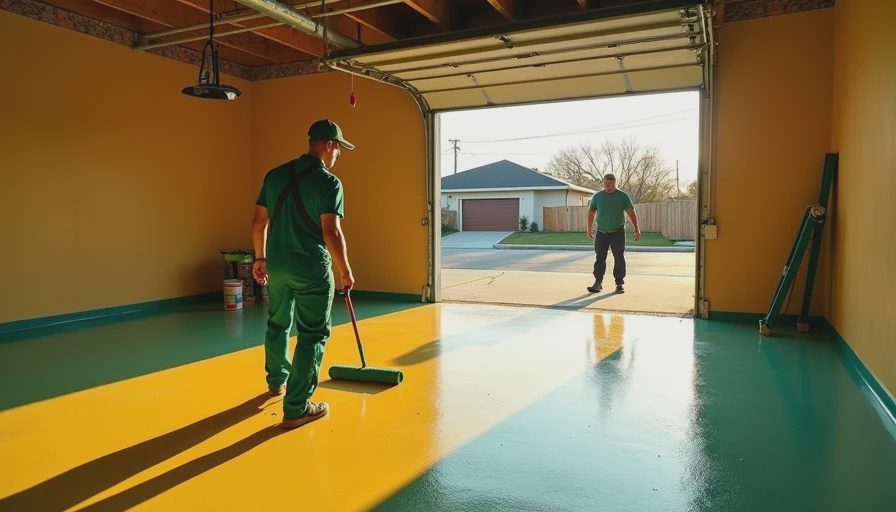
The base coat is where most people go wrong. Roll it too thick and the additive sinks. Roll it too thin and you get holiday stripes. Aim for an even, wet-looking film.
After the topcoat is down, broadcast a light extra pass of fine additive and roll over it. This gives even grip without sandpaper feel. Keep the garage shut for 24 hours. Wait 72 hours before parking a car, and a week before dropping a floor jack on it.
What I Screwed Up So You Don't Have To
My first attempt was a mess. I stirred cheap play sand into the epoxy and rolled it over an unprepared floor. It failed within eight months. I also applied one in late October when the temperature dropped to 50 at night, and the epoxy cured soft and chalky. Keep the garage above 60 degrees for the full cure cycle.
Another mistake was skipping that broadcast pass. A medium texture hides dust and imperfections. My rule now is to mix in additive and broadcast a little extra in high-traffic areas like the workbench zone.
Is It Worth It?
A non slip epoxy coating for concrete is worth the weekend and the money, especially if you work in your garage. My current floor is three years old, and I've never slipped, even when I spilled gear oil after a tire rotation. I've installed it in clients' homes with daily drivers and kids crossing all day.
Don't trust the glossy demo videos. Buy a proper system, spend time on prep, and use a non slip additive from the start. You'll avoid the slippery surface, the peeling corners, and the six-hour redo I already paid for. Back to the bench.